Hanoi Motorbike Sightseeing Tour: Best Places to Visit
A Hanoi Motorbike Sightseeing Tour is not simply a faster way to move between attractions. The real appeal is being able to connect very different parts of the city in a single journey: crowded markets, colonial streets, residential alleys, historic bridges, lakes, riverside farms and quiet neighborhoods. Instead of spending the whole day around the same central attractions, you can see how Hanoi changes from one street to the next. A current sightseeing route from Motorbike City Tours combines the Old Quarter, Long Bien Bridge, Banana Island, West Lake, Huu Tiep Lake, Train Street and several major landmarks in one half-day experience.
1. Hanoi Old Quarter
Start with the Old Quarter, but don’t think of it as simply another sightseeing stop. From the back of a scooter, the Old Quarter becomes a moving street scene. Narrow lanes, tiny shops, cafés, food stalls, houses and people going about their daily routines appear almost continuously. The advantage of a motorbike is that you can move beyond the most photographed streets and enter smaller lanes where the atmosphere feels much more residential.
A good guide will also help you understand why the Old Quarter looks so different from modern parts of Hanoi. The narrow streets reflect centuries of commercial activity, while the architecture shows layers of Vietnamese and French influence. Current Hanoi motorbike itineraries specifically use backstreets and alleys rather than concentrating only on the major tourist roads.
2. Dong Xuan Market
Dong Xuan Market is one of the best places to understand Hanoi’s commercial side. Rather than treating the market as a quick photo stop, look at what is actually happening around it: deliveries, wholesale trading, street vendors, small businesses and people buying everyday products.
A motorbike tour can pass through the market area before continuing toward the Red River, making it part of a much larger story about how Hanoi developed around trade and transportation. Current sightseeing routes from Motorbike City Tours include Dong Xuan Market among their highlights.
3. French Quarter
The French Quarter provides one of the most noticeable changes in scenery during the tour. Suddenly, the narrow streets give way to wider boulevards, old villas, mature trees and grand colonial-era buildings.
This section is particularly interesting for travelers who want to photograph Hanoi’s architecture. You don’t necessarily need to enter every building to appreciate the area; simply riding through it allows you to see how dramatically Hanoi’s urban design changes within a short distance.
4. Hanoi Opera House
The Hanoi Opera House is one of the architectural landmarks usually viewed from outside during a motorbike sightseeing route. Its grand French-inspired appearance creates a strong contrast with the much more compact streets of the Old Quarter.
The attraction of seeing it by motorbike is the surrounding journey. You are not simply transported there, take one photograph and leave. The Opera House becomes one part of a continuous route connecting Hanoi’s historic districts. Current motorbike itineraries list the Opera House among the landmarks passed during the tour.
5. Long Bien Bridge
If there is one place that should be high on your Hanoi motorbike sightseeing list, it is Long Bien Bridge.
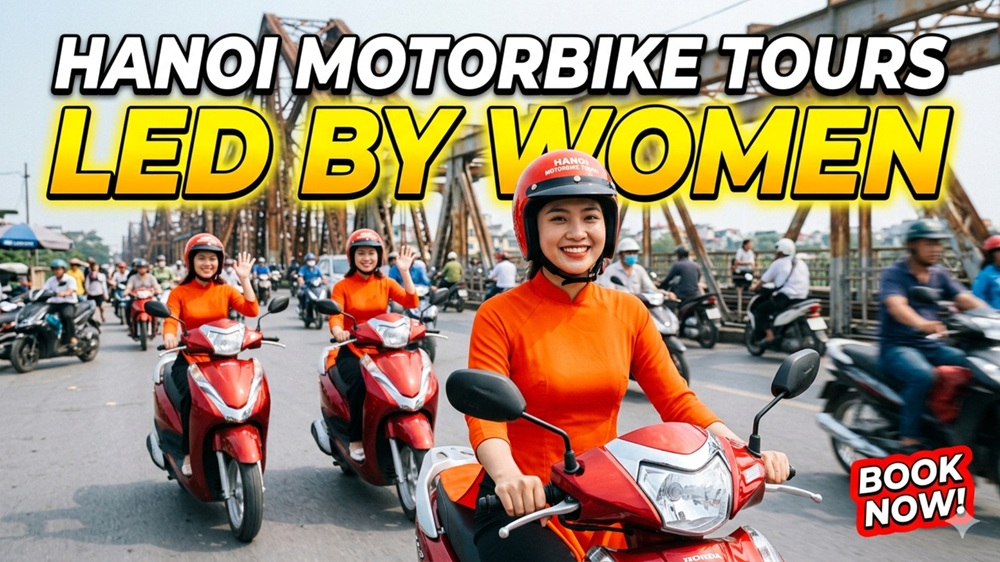
The historic steel bridge crosses the Red River and provides a completely different perspective of the city. From the bridge, you can look down toward the riverbanks, agricultural land and Banana Island while seeing Hanoi’s dense urban area stretching behind you.
The bridge was built in 1902 and remains an important part of Hanoi’s visual identity.
A motorbike is particularly suitable here because crossing the bridge becomes part of the experience rather than simply viewing it from a distance.
6. Banana Island
This is where the tour can surprise first-time visitors.
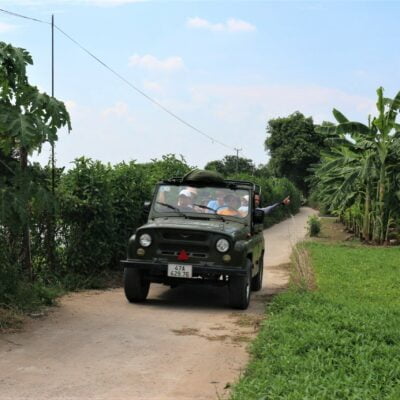
Just beyond the urban streets of Hanoi, Banana Island feels surprisingly green and rural. Dirt paths run between banana and guava trees, vegetable gardens and cultivated land. It is difficult to believe that such a landscape exists so close to the city center.
Motorbike tours can reach areas that are impractical for larger vehicles, which makes Banana Island one of the strongest reasons to choose a scooter-based sightseeing experience. Current routes specifically describe riding along dirt paths through Hanoi’s agricultural countryside.
7. Red River
The Red River is not always treated as a conventional tourist attraction, but it is essential to understanding Hanoi.
The river shaped the city’s development, transportation, agriculture and settlement patterns. When you cross Long Bien Bridge and look toward the riverbanks, you can see a side of Hanoi that is very different from the busy streets around Hoan Kiem Lake.
The combination of bridge, river, farmland and city skyline also makes this one of the most interesting photography sections of a motorbike tour.
8. West Lake
After the intensity of central Hanoi, West Lake provides a completely different mood.
The roads around the lake are more open, the scenery is less compressed and the water creates a welcome sense of space. It is an ideal section of the tour for slowing down, taking photographs and enjoying the breeze.
Current motorbike sightseeing itineraries include West Lake as one of the major sightseeing areas.
If you are visiting Hanoi during a hot period, this can also be one of the most comfortable parts of the ride.
9. Truc Bach Lake
Next to West Lake is Truc Bach Lake, a smaller and more intimate body of water surrounded by streets, cafés and historic sites.
The area is particularly attractive because it combines water, old architecture and everyday city life. Instead of being surrounded entirely by major tourist attractions, you see restaurants, residential buildings and people using the area as part of their normal routine.
Current Hanoi motorbike routes include Truc Bach Lake among the landmarks viewed along the journey.
10. Tran Quoc Pagoda
Located beside West Lake, Tran Quoc Pagoda is one of Hanoi’s best-known Buddhist landmarks.
Even if the motorbike itinerary only passes the area rather than spending a long period inside the pagoda, the location is worth seeing because of its setting beside the water. The combination of the pagoda, lake and surrounding trees creates one of the more peaceful visual moments of a Hanoi sightseeing ride.
For travelers interested in photography, the approach to the pagoda can be just as interesting as the monument itself.
11. Huu Tiep Lake and the B-52 Wreckage
One of the most unusual stops is Huu Tiep Lake, where the remains of a B-52 bomber are preserved in the water.
The setting makes the experience especially striking. Instead of seeing a war relic in a large museum, you encounter it in a relatively ordinary residential neighborhood. Houses, narrow lanes and everyday life surround an object connected to a major period of Vietnamese history.
Current Hanoi motorbike itineraries specifically include Huu Tiep Lake and the B-52 wreckage.
12. Ho Chi Minh Mausoleum Area
The Ho Chi Minh Mausoleum complex is another major landmark commonly viewed from outside during motorbike sightseeing tours.
This part of the route is useful for understanding the political and historical importance of central Hanoi. The surrounding streets are considerably more spacious than the Old Quarter, and the architecture and landscaping create another noticeable change in atmosphere.
Motorbike City Tours currently lists the Ho Chi Minh Mausoleum area as an outside-view landmark rather than presenting it as a full indoor attraction visit.
13. Temple of Literature
The Temple of Literature is one of Hanoi’s most important historic sites and is frequently passed on city sightseeing routes.
The attraction represents Vietnam’s long educational and scholarly tradition, making it especially interesting for visitors who want historical context rather than only modern city scenery.
If you have additional time after your motorbike tour, the Temple of Literature is one of the places worth returning to for a slower visit.
14. Hanoi Train Street
Hanoi Train Street is perhaps the city’s most unusual urban attraction.
The railway runs through a narrow residential area where homes and businesses sit remarkably close to the tracks. The attraction is not simply about waiting for a train; it is the unusual relationship between railway infrastructure and everyday city life.
Because access and safety arrangements can change, visitors should follow their guide’s instructions and only view the railway from permitted areas. Current motorbike itineraries include the Train Street neighborhood, but the experience should always prioritize safety.
15. Hanoi’s Hidden Alleys
One of the biggest differences between a motorbike sightseeing tour and a conventional sightseeing bus is the ability to explore small alleys.
These lanes are where you can see another side of Hanoi: tiny houses, family businesses, neighborhood cafés, children playing, food vendors and residents moving through their daily routines.
The alleys are not necessarily famous attractions—and that is exactly why they are interesting. Current Motorbike City Tours itineraries make hidden backstreets an important part of their routes.
16. Local Markets
Hanoi’s markets provide another opportunity to see the city through everyday activity rather than monuments.
A motorbike can pass through or near busy market areas where fresh produce, household goods, flowers and food are traded. Dong Xuan Market is the most prominent example, but smaller neighborhood markets can provide an even more intimate look at daily life.
If photography is important to you, markets are often more visually interesting than conventional monuments because the scene constantly changes.
17. Hanoi’s Agricultural Countryside
Perhaps the biggest surprise of a city tour is discovering that Hanoi contains genuine agricultural landscapes.
Banana trees, vegetable gardens, dirt paths and cultivated land appear after only a short ride from the dense center. This creates one of the strongest contrasts in the entire itinerary.
A current Hanoi Motorbike Tour itinerary divides the experience into city exploration followed by a countryside section around Banana Island.
18. Local Neighborhoods
Between the famous attractions are the neighborhoods that give Hanoi its personality.
This is where a knowledgeable guide adds real value. Instead of simply pointing out a building, the guide can explain what kind of neighborhood you are passing through, how people use the streets and why Hanoi developed in this particular way.
That makes the journey itself part of the sightseeing.
19. Vietnamese Food Stop
A sightseeing tour does not have to be completely separate from Hanoi’s food culture.
Depending on the itinerary, the experience can finish with a Vietnamese meal or food stop. Current Motorbike City Tours information includes Vietnamese lunch and drinks within its City Insight experience.
This is useful because you can spend most of the tour exploring Hanoi and still finish with a taste of Vietnamese cuisine.
20. Egg Coffee
End the sightseeing experience with Vietnamese Egg Coffee, one of Hanoi’s signature drinks.
The combination of strong Vietnamese coffee and a creamy egg topping makes it very different from standard Western coffee. Current motorbike sightseeing itineraries include Egg Coffee or another Vietnamese dessert at the end of the experience.
After several hours on the road, sitting down for coffee is also a natural way to finish the tour.
Best Places to Visit on a Hanoi Motorbike Tour
If you want to prioritize the strongest stops, I would rank them like this:
| Rank | Place | Why Visit |
|---|---|---|
| 1 | Long Bien Bridge | History, Red River views, photography |
| 2 | Banana Island | Unexpected countryside inside Hanoi |
| 3 | Old Quarter Alleys | Everyday Hanoi and street life |
| 4 | West Lake | Open scenery and relaxed atmosphere |
| 5 | Huu Tiep Lake | B-52 historical relic |
| 6 | Train Street | Unique railway neighborhood |
| 7 | Dong Xuan Market | Markets and everyday commerce |
| 8 | French Quarter | Colonial architecture |
| 9 | Truc Bach Lake | Lakeside scenery and history |
| 10 | Hanoi Opera House | Iconic architecture |
| 11 | Temple of Literature | Vietnamese education and history |
| 12 | Ho Chi Minh Mausoleum Area | Important modern Vietnamese history |
What Makes These Places Different?
The strength of a Hanoi Motorbike Sightseeing Tour is not that it visits twenty famous attractions one after another. It is that the route connects completely different environments.
You might begin among the tightly packed streets of the Old Quarter, move into the elegant French Quarter, cross the Red River, suddenly find yourself surrounded by farmland on Banana Island, return to the city around West Lake, pass a wartime B-52 relic and finish with coffee.
That contrast is what makes the experience memorable.
Best Route for First-Time Visitors
For a first visit, a balanced route would be:
Old Quarter → Dong Xuan Market → Long Bien Bridge → Red River → Banana Island → West Lake → Truc Bach Lake → Huu Tiep Lake → Train Street → Vietnamese lunch → Egg Coffee.
This route gives you architecture, history, countryside, lakes, markets, street life and food without spending the entire day inside museums or formal attractions. The current City Insight itinerary follows a similar concept, combining central Hanoi with the Red River countryside and lakeside areas.
How Long Do You Need?
A typical Hanoi sightseeing motorbike tour takes around 4–4.5 hours. Current published itineraries from Motorbike City Tours offer morning and afternoon departures, with the experience covering both central Hanoi and areas beyond the Old Quarter.
Four hours is enough for a strong introduction, but it is not enough to enter every attraction.
That is actually an advantage for travelers with limited time: you can see a large portion of Hanoi first and then decide which places deserve a longer independent visit.
Should You Choose Morning or Afternoon?
Choose morning if you want cooler conditions, softer light for photography and a quieter start.
Choose afternoon if you prefer to sleep later, have breakfast slowly and combine your ride with evening activities afterward.
If photography is your priority, morning light around Long Bien Bridge and the Red River can be particularly attractive. If you want to experience Hanoi becoming more energetic, the afternoon route provides a different atmosphere.
Is a Motorbike Better Than a Car for Sightseeing?
For this particular style of itinerary, yes, in many cases.
A car is more comfortable and provides air conditioning, but a motorbike can access narrower roads and provides a much closer view of street life.
The biggest advantage is not speed. It is access.
You can move from a main boulevard into a tiny alley, from the city into farmland and from a crowded market to a quiet lakeside road without changing vehicles.
Do You Need to Drive?
No. On a guided passenger tour, you sit behind an experienced driver.
Current Motorbike City Tours information describes comfortable Honda Lead scooters with passenger backrests and professional licensed riders. Helmets and rain protection are also provided.
That means you can concentrate on looking around, taking photographs and listening to your guide rather than dealing with Hanoi traffic yourself.
Final Thoughts
The best Hanoi Motorbike Sightseeing Tour is not necessarily the one with the longest list of attractions. It is the one that shows you different sides of the city within the same journey.
The most worthwhile combination is Old Quarter + Long Bien Bridge + Banana Island + West Lake + Huu Tiep Lake + Train Street, followed by Vietnamese food and Egg Coffee. These places collectively show Hanoi as a historic capital, a crowded modern city, a riverside community and an unexpectedly green agricultural area.
For first-time visitors, a 4–4.5-hour Hanoi Motorbike Sightseeing Tour is enough to get a broad introduction to the city without spending the entire day in transit. For repeat visitors, a private or countryside-focused route can go further beyond the standard attractions.
Website: Motorbike City Tours
motorbikecitytours.com – Official Website
📞 Call / WhatsApp 24/7: +84 988 402 008
📧 Email: info@motorbikecitytours.com