
Hanoi Jeep Tour Through Historic Hanoi
A Hanoi Jeep Tour Through Historic Hanoi is a unique way to discover the capital’s long and complicated history while experiencing the city as it exists today. Instead of visiting historical attractions one by one, you travel through the streets where Hanoi’s past and present continue to exist side by side.
From the ancient streets of the Old Quarter and French colonial architecture to the historic Long Bien Bridge, Ho Chi Minh Mausoleum, Temple of Literature, Huu Tiep Lake, and the Red River countryside, a Jeep Tour can connect many different chapters of Hanoi’s story in a single journey. Current Hanoi Jeep itineraries combine major landmarks with hidden alleys, local markets, Banana Island, West Lake, Train Street, and local food.
Why Explore Historic Hanoi by Jeep?
Hanoi has a history stretching across more than a thousand years, but its history is not confined to museums. It can be seen in old streets, temples, colonial buildings, railway infrastructure, bridges, lakes, markets, neighborhoods, and even ordinary residential areas.
A Jeep Tour makes it possible to move between these different historical environments efficiently while still experiencing Hanoi’s streets at close range.
Instead of spending several hours inside a closed vehicle, you can feel the city’s atmosphere as you travel. You see local residents, hear the traffic, smell street food, photograph historic buildings, and listen to stories from a local guide.
The Old Quarter: Where Hanoi’s Commercial History Comes Alive
The Old Quarter is one of the most important places to begin understanding historic Hanoi.
The area developed around traditional streets and specialized trades, with the names of many streets reflecting the products and occupations historically associated with them. Historical sources describe the Old Quarter as the surviving core of the city’s old street layout and a long-standing commercial center.
Today, the Old Quarter remains crowded and energetic.
As your Jeep moves through the area, you can see old tube houses, small businesses, cafés, restaurants, street vendors, temples, and narrow lanes alongside modern shops.
The result is a fascinating mixture of old Hanoi and contemporary city life.
Hoan Kiem Lake and the Heart of Hanoi
Hoan Kiem Lake is closely connected with Hanoi’s identity.
Located beside the Old Quarter, the lake provides a peaceful contrast to the surrounding streets. Ngoc Son Temple, The Huc Bridge, and Turtle Tower add layers of history and symbolism to the landscape.
A Jeep Tour can take you around the area while your guide explains the stories and traditions connected with the lake.
For photographers, the contrast between the calm water and busy streets nearby creates excellent opportunities for capturing Hanoi’s character.
The French Quarter
Another important chapter in Hanoi’s history is visible in the French Quarter.
Broad streets, colonial villas, government buildings, hotels, and architectural landmarks reflect the transformation of Hanoi during the French colonial period.
The French influence remains visible in many parts of central Hanoi, including the Opera House and Presidential Palace. Historical sources identify the Hanoi Opera House and Presidential Palace among the city’s important French-era architectural landmarks.
Traveling from the narrow Old Quarter into the spacious French Quarter allows you to see this architectural contrast within a short distance.
Hanoi Opera House
The Hanoi Opera House is one of the most recognizable examples of French colonial architecture in the city.
Construction began in 1901 and the building was completed in 1911. Its design was influenced by European theater architecture and it became an important cultural and historical landmark.
During a Jeep Tour, you can admire the building from the surrounding streets and learn about its role in Hanoi’s history.
It is also an excellent photography stop.
Hanoi Flag Tower
The Hanoi Flag Tower is another historic landmark along the route.
Located within the wider Ba Dinh area, the tower is an important surviving structure associated with the city’s military and historical development.
Seeing it alongside the French colonial buildings and modern Hanoi provides a visual reminder of how many different periods are represented within a relatively small part of the capital.
The Temple of Literature
The Temple of Literature takes you much further back in Hanoi’s history.
The site was founded in 1070 during the Ly dynasty and became home to Quốc Tử Giám, traditionally recognized as Vietnam’s first university, in 1076. It remains an important symbol of Vietnamese education, scholarship, architecture, and Confucian traditions.
Although some Jeep itineraries pass the Temple of Literature rather than including an extended interior visit, it is an important historical landmark to understand when exploring Hanoi.
Your guide can explain how education and scholarship influenced Vietnamese society and why the site remains culturally important today.
Thang Long Imperial Citadel
Hanoi’s history extends even further through the story of Thang Long Imperial Citadel, the former imperial center of the city.
The historic citadel represents centuries of political and cultural development and is recognized as a World Cultural Heritage site. Historical sources identify it as one of Hanoi’s most important heritage areas near Ba Dinh Square.
Even when the Jeep route does not include a long visit inside the citadel, the surrounding area helps place Hanoi’s modern streets within their much older historical context.
Ho Chi Minh Mausoleum and Ba Dinh Square
The Ba Dinh area represents a very different period of Hanoi’s history.
The Ho Chi Minh Mausoleum, Ba Dinh Square, Presidential Palace, National Assembly Hall, and surrounding government buildings are important landmarks associated with modern Vietnam.
Current Hanoi Jeep itineraries pass through this area and include the Ho Chi Minh Mausoleum complex and Presidential Palace among their major highlights.
The wide streets and formal architecture create a strong contrast with the narrow lanes of the Old Quarter.
The Presidential Palace
The Presidential Palace is another striking example of French colonial architecture.
The building was constructed between 1901 and 1906 and was designed by architects Auguste Henri Vildieu and Charles Lichtenfelder. It later became associated with Vietnam’s modern political history.
From the Jeep, you can appreciate the building’s architecture while your guide explains its place in Hanoi’s historical landscape.
Huu Tiep Lake and the B-52 Wreckage
One of the most unusual historical locations on a Hanoi Jeep Tour is Huu Tiep Lake, where the remains of a B-52 aircraft can be seen.
The wreckage sits within a residential neighborhood, creating a remarkable contrast between wartime history and ordinary modern Hanoi life.
Rather than being separated from the city inside a museum, this historical reminder exists in the middle of a living neighborhood.
This makes the location particularly powerful for travelers interested in modern Vietnamese history.
Long Bien Bridge: A Living Historical Monument
Long Bien Bridge is perhaps the most iconic historical structure on a Hanoi Jeep Tour.
Construction began in the late 19th century and the bridge was completed in the early 20th century during the French colonial period. It was originally named Paul Doumer Bridge and became the first major steel bridge across the Red River in Hanoi.
The bridge later suffered extensive damage during wartime bombing, with parts destroyed and subsequently rebuilt. Today, its surviving structure remains a powerful reminder of Hanoi’s turbulent 20th century.
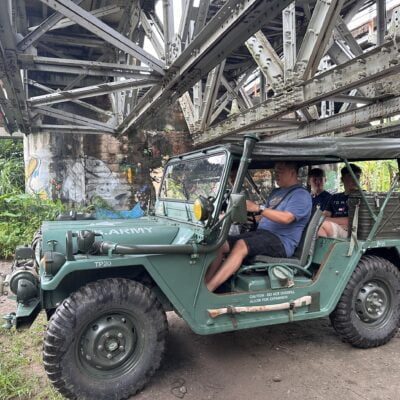
Crossing Long Bien Bridge in a Jeep allows you to experience this history while looking directly at the Red River and the modern city surrounding it.
The Red River
The Red River is essential to understanding Hanoi.
The city’s location and development have always been closely connected with waterways, agriculture, transportation, and trade.
From Long Bien Bridge, you can see the river landscape stretching beyond the dense urban center.
The view helps explain why Hanoi developed where it did and how the city has expanded over time.
Banana Island: Hanoi’s Rural Past and Present
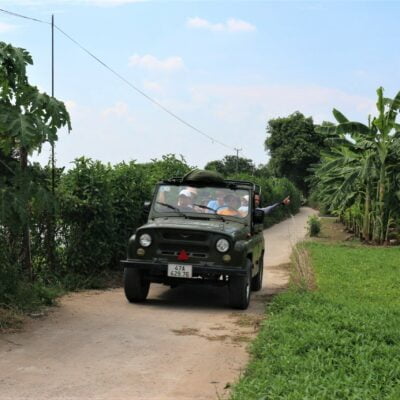
After crossing Long Bien Bridge, the Jeep can take you toward Banana Island, an agricultural area surrounded by the Red River.
The landscape changes dramatically.
Instead of dense streets and colonial buildings, you see gardens, farmland, banana trees, dirt paths, and local agricultural activity.
Current Hanoi Jeep itineraries specifically include Banana Island as a green escape from the city’s urban environment.
This part of the journey is important because it demonstrates that Hanoi is not simply a dense modern metropolis.
Rural life remains surprisingly close to the city center.
Hanoi’s Hidden Alleys
Historic Hanoi is not only found at famous monuments.
Some of the city’s most interesting stories can be found in its hidden alleys and residential neighborhoods.
Current Jeep routes include narrow lanes, local homes, schools, markets, trading areas, and streets that are often overlooked by conventional sightseeing tours.
Driving through these areas allows you to see how Hanoi’s historic urban fabric continues to function in everyday life.
Old houses may stand beside modern buildings. Small family businesses operate from ground-floor rooms. Local cafés sit next to traditional markets.
This mixture is one of the defining characteristics of Hanoi.
Train Street and Hanoi’s Railway History
Train Street represents another fascinating chapter in Hanoi’s urban development.
The railway passes directly through a densely populated neighborhood, creating an unusual relationship between transportation infrastructure and residential life.
The area is now famous among international travelers, but it remains part of a living neighborhood.
Current Jeep itineraries include the Reunification Railway Street area.
Access and safety conditions can change, so travelers should follow their guide’s instructions and remain in permitted areas.
West Lake and Truc Bach Lake
Hanoi’s history is also closely connected to its lakes.
West Lake provides a large natural landscape within the city, while Truc Bach Lake offers a smaller and more intimate environment.
Current Jeep routes include both areas, along with Tran Quoc Pagoda.
The lakes provide a welcome contrast to Hanoi’s dense streets and create opportunities to understand how water, temples, gardens, and residential neighborhoods have shaped the city’s development.
Tran Quoc Pagoda
Tran Quoc Pagoda is one of Hanoi’s most important Buddhist landmarks.
Located beside West Lake, the pagoda provides a peaceful environment away from the traffic and activity of central streets.
A visit or pass through this area adds a spiritual and cultural dimension to a historical Jeep Tour.
It also demonstrates that Hanoi’s history is not only political or military. Religion, education, architecture, and community traditions have all played important roles in shaping the city.
Local Markets and Traditional Life
Markets provide another window into historic Hanoi.
While modern supermarkets and shopping centers have transformed the way people shop, traditional markets continue to play an important role in many neighborhoods.
A Jeep Tour can take you through busy local markets where you may see fresh produce, fish, meat, household goods, clothing, tools, and street food.
These places are particularly valuable for travelers who want to understand everyday Hanoi rather than simply visit monuments.
Hanoi’s Food History
Food is another way to experience the city’s history.
Traditional Hanoi dishes have developed through generations and remain an important part of local identity.
A Jeep Tour can combine historical sightseeing with local food stops, allowing you to taste dishes while learning about the neighborhoods where they are prepared.
Current Jeep itineraries include a local meal and can finish with Vietnamese Egg Coffee or Mango and Caramel Pudding.
This combination makes the tour more than a history lesson.
You experience Hanoi through its streets, buildings, people, food, and landscapes.
Hanoi’s History Through Architecture
One of the easiest ways to understand Hanoi’s history is to look at its architecture.
Traditional Vietnamese houses can be found alongside French colonial buildings. Historic temples stand near modern apartment buildings. Government architecture sits close to local markets and narrow residential lanes.
The result is a city where different periods overlap rather than existing in separate districts.
A Jeep Tour makes these contrasts particularly visible because you can travel through several architectural environments in just a few hours.
What Makes a Jeep Tour Different?
A conventional historical tour may focus mainly on major monuments.
A Jeep Tour connects the monuments with the neighborhoods around them.
You don’t simply see Long Bien Bridge; you cross it and observe the Red River.
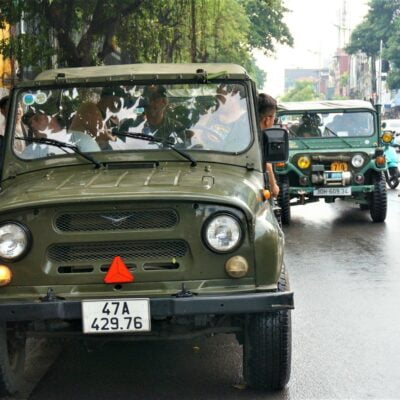
You don’t simply hear about French colonial Hanoi; you drive through the French Quarter and see the architecture around you.
You don’t simply learn about rural Hanoi; you travel through Banana Island and see farmland beside the city.
You don’t simply visit historical landmarks; you see how people live around them today.
Morning Hanoi Jeep Tour Through History
The morning departure currently runs approximately from 8:00 AM to 12:30 PM.
Morning can be an excellent time for travelers interested in historical and cultural photography because the streets are active while temperatures are generally more comfortable than later in the day.
The current itinerary includes a local lunch at the end of the morning experience.
Afternoon Hanoi Jeep Tour Through History
The afternoon experience currently runs approximately from 1:00 PM to 5:30 PM.
This schedule works well for travelers who want to spend the morning independently exploring Hanoi before joining the Jeep.
The afternoon light can also be attractive for photography, particularly around Long Bien Bridge and the Red River landscape.
Evening Hanoi Jeep Tour Through History
The sunset and evening experience currently runs approximately from 5:30 PM to 9:30 PM.
This version adds a completely different atmosphere to historic Hanoi.
The Old Quarter becomes busier, restaurants begin serving dinner, buildings become illuminated, and Hanoi’s streets transition from daylight into nightlife.
For travelers interested in combining history with food and photography, the evening option can be particularly memorable.
Private Hanoi Jeep Tour Through Historic Hanoi
A private Jeep Tour is a good option if history is your main interest.
You can spend more time discussing particular landmarks with your guide and potentially adjust the route around your interests.
Couples, families, photographers, and small groups can particularly benefit from having a dedicated Jeep and guide.
The current official women-led Jeep page lists a private city experience at US$80 per person, although travelers should confirm the current price and exact inclusions when booking.
What Should You Expect?
You should expect a combination of history and everyday life.
The tour is not conducted entirely inside museums or historical monuments. Much of the experience happens while traveling through Hanoi’s streets.
You will see motorbikes, street vendors, markets, homes, cafés, schools, historic buildings, lakes, bridges, farmland, and modern businesses.
That is precisely what makes a Jeep Tour through historic Hanoi different.
You are seeing history as part of a living city.
What Should You Wear?
Because the Jeep is open-air, comfortable clothing is recommended.
Comfortable shoes are useful for walking during stops. Sunglasses and sunscreen can be useful during sunny weather, while a light jacket can be helpful during cooler months.
The Jeep has a retractable roof, and current tour information states that rain ponchos are available and tours operate in rain or shine.
Final Thoughts
A Hanoi Jeep Tour Through Historic Hanoi is an opportunity to experience the capital as a living history book.
The journey can take you from the traditional streets of the Old Quarter to French colonial Hanoi, from the Temple of Literature and Ba Dinh area to the wartime history of Huu Tiep Lake, from Long Bien Bridge and the Red River to the agricultural landscape of Banana Island.
Along the way, you can discover West Lake, Truc Bach Lake, Tran Quoc Pagoda, Train Street, local markets, hidden alleys, Vietnamese food, and the everyday neighborhoods that connect Hanoi’s past with its present.
Hanoi’s history is not confined to a single monument.
It is in the streets, bridges, lakes, buildings, markets, temples, railway lines, homes, and people.
A Jeep Tour simply gives you a more exciting way to travel through it all.
Book a Hanoi Historic Jeep Tour
Hanoi Jeep Tours – Led by Women
Address: 91 Tho Nhuom Street, Hoan Kiem District, Hanoi, Vietnam
WhatsApp: +84 982 416 518 / +84 981 090 989
Email: toursjeephanoi@gmail.com
Official Website: Hanoi Jeep Tours Official Website
Explore historic Hanoi by open-air Jeep and discover the stories behind the Old Quarter, French Quarter, Long Bien Bridge, Ba Dinh, Banana Island, West Lake, Train Street, and the city’s hidden neighborhoods.